
Familial Amyloid Polyneuropathy Market to Reach USD 5.56 Billion by 2031, Driven by RNA-Silencing Therapies and Earlier Genetic Diagnosis
Hyderabad, India, November 27, 2026:
Familial Amyloid Polyneuropathy Market Overview
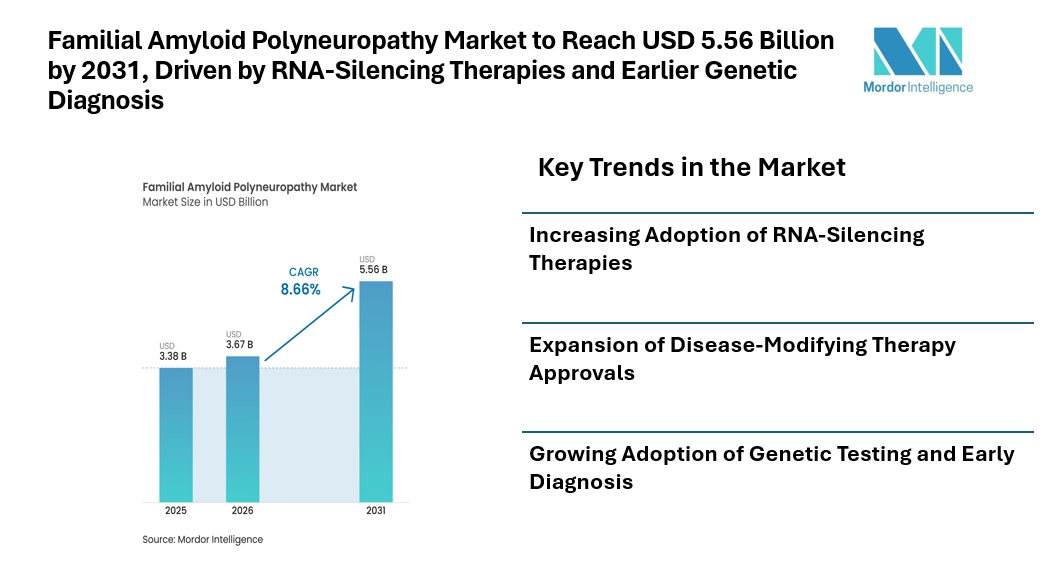
According to Mordor Intelligence, the familial amyloid polyneuropathy market size is estimated at USD 3.67 billion in 2026 and is projected to reach USD 5.56 billion by 2031, registering a CAGR of 8.66% during the forecast period. The market was valued at USD 3.38 billion in 2025, reflecting increasing demand for disease-modifying treatments, genetic diagnostic services, and specialized amyloidosis care.
The familial amyloid polyneuropathy industry is witnessing growing adoption of transthyretin (TTR)-targeted therapies, particularly RNA-silencing medicines and TTR stabilizers. Advances in small interfering RNA and antisense oligonucleotide technologies are supporting more effective approaches to reducing abnormal transthyretin production. Additionally, expanding genetic testing programs and family-cascade screening are improving the identification of presymptomatic carriers and patients with hereditary transthyretin amyloidosis. Increasing availability of monthly and quarterly treatment options is also supporting the transition toward more convenient patient management.
North America held the largest regional share of the familial amyloid polyneuropathy market in 2025, accounting for 45.61% of the global market, supported by established rare-disease treatment infrastructure, access to advanced therapies, and specialized diagnostic services. Asia-Pacific is expected to register the fastest growth during the forecast period, with a projected CAGR of 11.25%, driven by expanding genetic screening programs, increasing awareness of hereditary amyloidosis, and improving access to disease-modifying treatments.
Report Overview: https://www.mordorintelligence.com/industry-reports/familial-amyloid-polyneuropathy-market?utm_source=abnewswire
Familial Amyloid Polyneuropathy Market Trends
Increasing Adoption of RNA-Silencing Therapies
RNA-silencing therapies are becoming an important component of familial amyloid polyneuropathy treatment as pharmaceutical companies focus on reducing the production of transthyretin proteins responsible for amyloid accumulation. Small interfering RNA and antisense oligonucleotide therapies are expanding treatment options for patients with hereditary transthyretin amyloidosis and supporting disease management across different patient populations.
The growing commercial adoption of these therapies is also influencing treatment preferences. Alnylam Pharmaceuticals’ AMVUTTRA, a quarterly subcutaneous RNA interference therapy, recorded USD 2.31 billion in global net product revenue in 2025. The expansion of its approved indications into transthyretin amyloid cardiomyopathy in March 2025 further strengthened its commercial position. Continued developments in RNA-based medicines and less frequent administration schedules are expected to support demand for advanced disease-modifying treatments.
Expansion of Disease-Modifying Therapy Approvals
Regulatory approvals for disease-modifying therapies are expanding the treatment landscape for familial amyloid polyneuropathy. Pharmaceutical companies are developing treatments targeting transthyretin production and stabilization, providing alternatives to conventional disease management approaches. These therapies are supporting improvements in treatment accessibility and broadening the range of options available to patients with hereditary transthyretin amyloidosis.
In March 2025, the European Commission approved eplontersen, marketed as WAINZUA, for Stage 1 and Stage 2 ATTRv polyneuropathy. Its monthly self-administered autoinjector format provides an additional treatment option for eligible patients. In July 2025, the European Commission also granted marketing authorization to ATTROGY (diflunisal) for adults with Stage 1 or Stage 2 polyneuropathy. Continued regulatory developments and clinical research are expected to strengthen the availability of disease-modifying treatments.
Growing Adoption of Genetic Testing and Early Diagnosis
Genetic testing is gaining importance in the diagnosis and management of familial amyloid polyneuropathy, particularly in regions with established hereditary transthyretin amyloidosis clusters. TTR gene sequencing and hereditary amyloidosis next-generation sequencing panels are helping identify pathogenic variants among patients and their family members. Earlier identification allows healthcare providers to monitor disease progression and assess treatment requirements before significant neurological impairment develops.
Family-cascade testing is also expanding the identified patient population. First-degree relatives of diagnosed patients can undergo genetic assessment and periodic monitoring to identify presymptomatic carriers. In addition, improvements in cardiac imaging and nuclear scintigraphy are supporting the identification of transthyretin-related cardiac involvement. These developments are strengthening the role of genetic laboratories, specialist diagnostic centers, and multidisciplinary amyloidosis services.
Expansion of Specialist Amyloidosis Centers and Home-Based Treatment
The development of specialist amyloidosis centers is improving the coordination of diagnosis, treatment, and long-term monitoring for patients with hereditary transthyretin amyloidosis. These centers bring together neurologists, cardiologists, genetic specialists, and diagnostic professionals to address the multisystem manifestations of the disease. Their growing presence is particularly important in regions with established hereditary disease clusters, including Portugal, Japan, Sweden, and Brazil.
At the same time, the availability of monthly and quarterly self-administered treatments is changing the delivery of care. Subcutaneous formulations and autoinjector-based therapies are reducing dependence on frequent hospital visits and supporting home-based treatment management. This transition is increasing the importance of specialty pharmacy services, patient education, and digital fulfillment channels. Continued expansion of specialist infrastructure and convenient treatment formats is expected to support market growth.
For more insights on the Japanese market report, please visit the Mordor Intelligence page: https://www.mordorintelligence.com/ja/industry-reports/familial-amyloid-polyneuropathy-market?utm_source=abnewswire
Familial Amyloid Polyneuropathy Market Segmentation
The familial amyloid polyneuropathy market is segmented by modality, disease stage, distribution channel, and geography.
-
By Modality
-
Treatment
-
TTR Stabilizers
-
TTR Gene Silencers
-
Gene-Editing Therapies
-
Supportive Care
-
Diagnosis
-
TTR Single-Gene Sequencing
-
Hereditary Amyloidosis Next-Generation Sequencing Panels
-
Targeted Variant Testing
-
Tissue Biopsy and Amyloid Subtyping
-
Nuclear Scintigraphy and Cardiac Imaging
-
Others
-
By Disease Stage
-
Stage 1
-
Stage 2
-
Stage 3
-
Presymptomatic Pathogenic TTR-Variant Carriers
-
By Distribution Channel
-
Hospital Pharmacies
-
Retail Pharmacies
-
Online and Digital Fulfillment
-
Other Distribution Channels
-
By Geography
-
North America
-
United States
-
Canada
-
Mexico
-
Europe
-
Germany
-
United Kingdom
-
France
-
Italy
-
Spain
-
Rest of Europe
-
Asia-Pacific
-
China
-
Japan
-
India
-
Australia
-
South Korea
-
Rest of Asia-Pacific
-
Middle East and Africa
-
GCC
-
South Africa
-
Rest of Middle East and Africa
-
South America
-
Brazil
-
Argentina
-
Rest of South America
Familial Amyloid Polyneuropathy Market Competitive Landscape
The familial amyloid polyneuropathy market is moderately concentrated, with pharmaceutical companies focusing on RNA-silencing medicines, transthyretin stabilizers, and emerging gene-editing technologies. Established biotechnology companies are strengthening their portfolios through clinical development, regulatory approvals, and expanded indications for existing therapies. Competition is increasingly influenced by treatment effectiveness, dosing convenience, patient eligibility, and reimbursement requirements.
The competitive environment is also being shaped by developments in genetic testing and specialized diagnostic services. Companies are investing in next-generation sequencing, targeted genetic testing, and imaging-based diagnostic solutions to support earlier disease identification. Meanwhile, pharmaceutical developers are exploring next-generation RNA-based treatments and gene-editing approaches to reduce transthyretin production. Continued clinical research and strategic collaborations are expected to influence the competitive landscape.
Key Players in the Familial Amyloid Polyneuropathy Market
-
Alnylam Pharmaceuticals, Inc.
-
Pfizer Inc.
-
AstraZeneca PLC
-
BridgeBio Pharma, Inc.
-
Regeneron Pharmaceuticals, Inc.
-
Ionis Pharmaceuticals, Inc.
-
Intellia Therapeutics, Inc.
-
Takeda Pharmaceutical Company Limited
-
Prothena Corporation plc
-
Novo Nordisk A/S
-
Silence Therapeutics plc
-
Arcturus Therapeutics Holdings Inc.
-
Ambry Genetics
-
Invitae Corporation
-
Labcorp
-
ARUP Laboratories
-
Life Molecular Imaging GmbH
-
Neurimmune AG
-
SOM BIOTECH, S.L.
-
YolTech Therapeutics Co., Ltd.
Conclusion
The familial amyloid polyneuropathy market is expected to maintain strong growth as pharmaceutical companies expand disease-modifying treatment options and healthcare providers increasingly adopt genetic testing and early diagnostic approaches. The growing use of RNA-silencing medicines, TTR stabilizers, and emerging gene-editing technologies is reshaping the treatment landscape. At the same time, family-cascade screening and specialist amyloidosis centers are improving patient identification and access to care.
North America is expected to retain its leading regional position, while Asia-Pacific is projected to register the fastest growth during the forecast period. Despite challenges associated with high treatment costs, reimbursement restrictions, safety-monitoring requirements, and limited specialist healthcare infrastructure, continued investment in rare-disease research and advanced diagnostic technologies is expected to support market expansion.
About Mordor Intelligence
Mordor Intelligence is a global market intelligence firm, founded in 2014, helping businesses make informed decisions through data-driven insights, industry expertise, and advanced analytics. With 550+ domain experts and on-ground specialists across 150+ countries, the company delivers comprehensive intelligence across aerospace & defense, agriculture, automation, automotive, chemicals & materials, consumer goods & services, electronics, energy & power, financial services, food & beverages, healthcare, hospitality & tourism, information & communications technology, and logistics.
Its offerings include syndicated industry reports and subscription platforms such as Synapse. Mordor Intelligence is ISO 9001:2015 and ISO/IEC 27001:2022 certified, a member of ESOMAR and the Market Research Society of India, and a four-time Great Place to Work® honoree. Learn more at mordorintelligence.com.
Media Contact
Company Name: Mordor Intelligence Private Limited
Contact Person: Jignesh Thakkar
Email: Send Email
Phone: +1 617-765-2493
Address:11th Floor, Rajapushpa Summit, Nanakramguda Rd, Financial District, Gachibowli
City: Hyderabad
State: Telangana 500008
Country: India
Website: https://www.mordorintelligence.com/


